Can you play Bumpy Flight solo?
Yes — start a run from the CREATE FLIGHT menu. Solo flying works by doing one thing at a time: stabilize the plane, complete the single action a prompt names, and return to the controls before the next task.
Co-op
Divide pilot, cabin and repair duties before takeoff — the split is the whole co-op design.
Updated
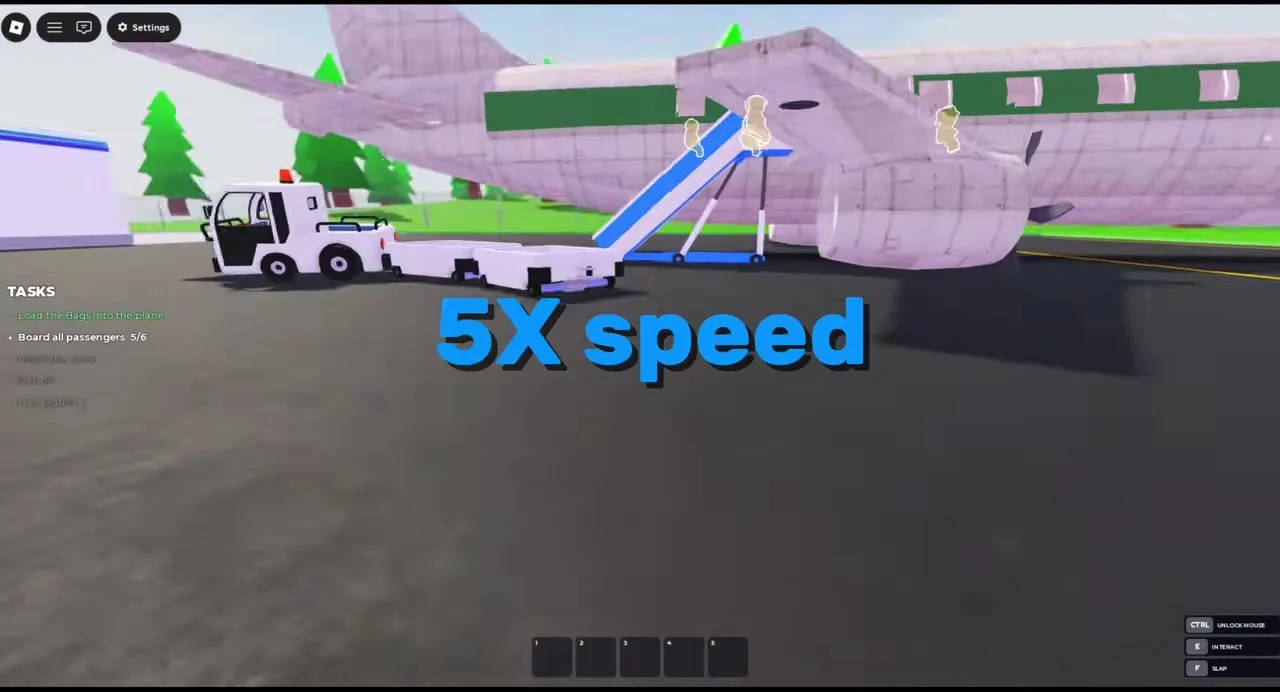
Bumpy Flight is built as a crew job — the official description's entire framing is "grab your friends and become the crew of your very own flight." Emergencies demand a pilot who never leaves the controls, someone answering the prompt, and someone keeping passengers alive. A crew without roles plays like three people doing one job badly.
Decide who flies before the baggage room, not mid-engine-failure.
The pilot flies and mostly keeps flying. Their job list: tap-based throttle and pitch, holding altitude through turbulence, making cabin announcements from the cockpit [E] prompt, and landing early rather than late.
The one rule that separates good pilots from dead ones: the pilot does not leave the seat to help. Every wipe story from experienced players starts with the controls going empty.
Cabin crew own passengers and supplies: boarding, luggage counting, fridge restocks, order-terminal deliveries from the wing, and the blanket-medicine routine during cold events.
It is the busiest role in a full cabin and the first one to feel understaffed. On four-player crews, splitting supplies from passenger care keeps both halves clean.
The engineer answers every wrench job: power box outages, engine failures, post-storm damage checks. They keep the wrench within reach and watch for damage prompts while the pilot flies.
A good engineer stands between the cockpit and the tail — mid-ship is the shortest path to both repair points.
Two players: one pilot who never leaves the controls, one floater who runs cabin, supplies and repairs. The floater's discipline — finish one action, then return — is what makes duos work.
Three players: add a dedicated engineer, which turns every repair event from a panic into a job. Four players: split cabin and supplies so the engineer never has to leave a warning unattended. Public servers hold up to 20 players, but a coordinated pair still beats a lobby of strangers filming the chaos.
| Crew size | Split | Watch out for |
|---|---|---|
| Solo | All roles, slow order | Do one prompt at a time, stabilize first |
| 2 players | Pilot + floater | Floater must return to the cabin between jobs |
| 3 players | Pilot + cabin + engineer | Cabin and supplies double up on one person |
| 4 players | Pilot + cabin + supplies + engineer | Keep talk active — silence loses flights |
The callouts that matter: which engine is damaged, whether the cabin or the wings need the next item, and when the pilot is about to descend. Everything else is noise.
Use Roblox chat or voice as your table needs, but agree on the three callouts before takeoff. A crew that names its emergencies finishes them.
Solo is a real way to play — the CREATE FLIGHT menu starts runs alone — but it changes the rhythm: stabilize first, then one action, then back to the controls. Nothing in the game requires fixing two things at once, and solo runs that respect that land safely.
Expect slower flights and carry the wrench habit: every solo run ends because someone raced the distance counter during an event.
FAQ
Yes — start a run from the CREATE FLIGHT menu. Solo flying works by doing one thing at a time: stabilize the plane, complete the single action a prompt names, and return to the controls before the next task.
One pilot who never leaves the controls, one cabin crew for passengers and supplies, and one engineer for repairs. With four players, split supplies from passenger care. With two, the second player floats between cabin and repairs.
Up to 20 players per server, but the game is designed around small coordinated crews — a disciplined pair usually outperforms a crowded lobby.